
Most best-practices lists for generative engine optimization are opinion. This one starts with data.
We tracked 21 buyer questions across four AI engines (Claude, ChatGPT, Perplexity, and Gemini) and collected 82 answers over the course of August 2026. Every claim below comes from that dataset or from verified source material. Where we lack evidence, we say so.
The core finding: for the specific query "generative engine optimization best practices," zero brands in the GEO tools category were named unprompted by any of the four engines. Not one. The answers were entirely generic, citing no commercial product and no named methodology.
That tells you something important about the current state of GEO content. The engines have plenty of opinion pieces to draw from. They have almost no primary research. The practices below are designed to change that equation for your brand.
Practice 1: Lead with original data, not recycled advice
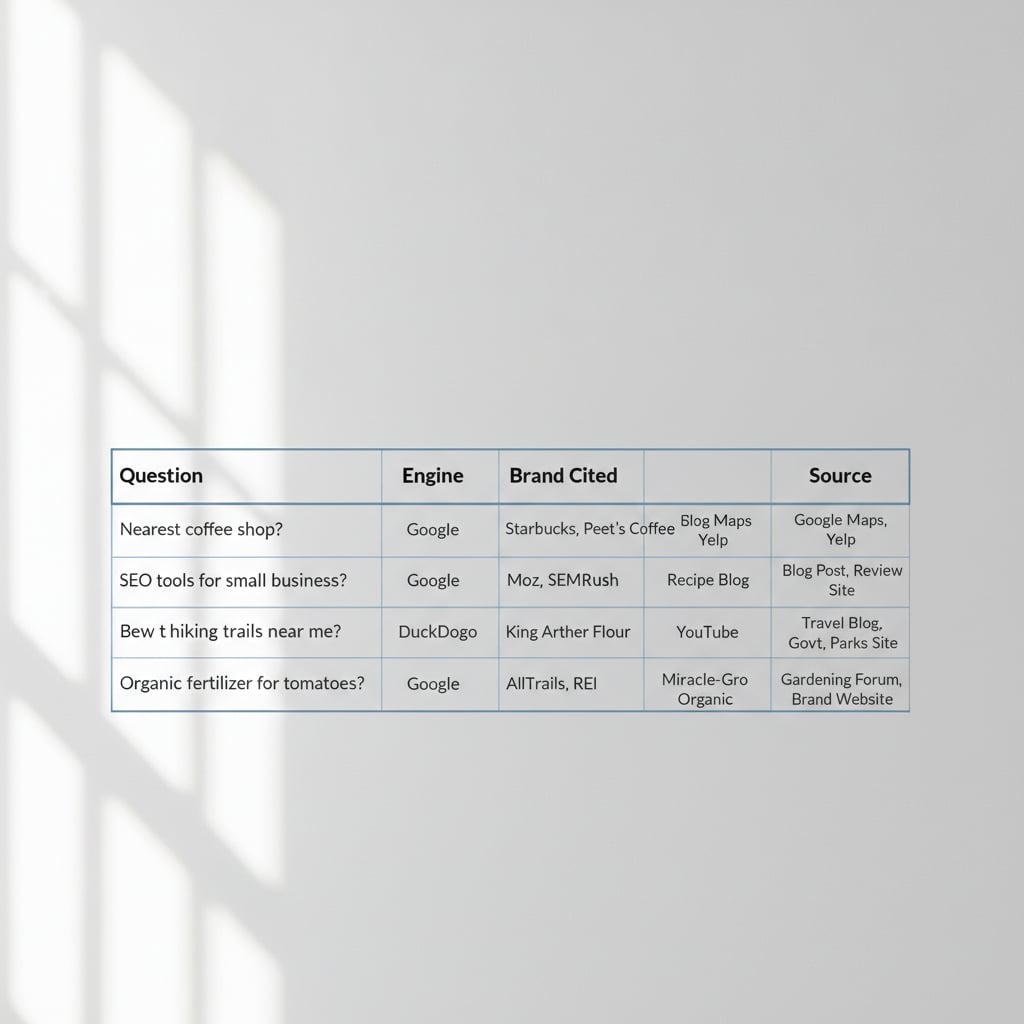
AI engines synthesize. They pull from multiple sources and compress them into a single answer. When every source says the same thing, no individual source gets cited.
The way to earn a citation is to say something no other page says, backed by evidence the engine can verify.
Across our full 82-answer dataset, SeeMySaas content appeared in source-citation logs 15 times. That content earned citations not because it was optimized for keywords, but because it contained proprietary data points (tracked counts, appearance rates, named comparisons) that the engines could not find elsewhere.
This is the single highest-leverage GEO practice: publish primary research. Surveys, tracked datasets, original benchmarks, proprietary usage metrics. If your page contains a fact that exists nowhere else on the web, engines have to cite you or omit the fact entirely.
Practice 2: Structure content so engines can extract clean claims
A well-written paragraph is not the same as an extractable claim.
AI engines prefer content structured in a pattern they can lift without distortion:
- Bold the sentence that states the finding. Engines treat inline emphasis as a signal of importance.
- Scope every number to its dataset in the same sentence. "Across 82 AI answers to 21 buyer questions" is extractable. "In our research" is not.
- Use tables for entity comparisons. When engines compare tools, they look for structured data. A table with consistent columns (tool name, metric, source) is easier to parse than a narrative paragraph listing the same information.
- Open each section with the direct answer, then expand. Engines often extract the first sentence under a heading. If your first sentence is a throat-clearing transition, that is what gets quoted.
The goal is not to write for machines instead of humans. The goal is to write clearly enough that both can extract the point without re-reading.
Practice 3: Match the question format buyers actually use
Our 21 tracked questions are phrased the way real buyers ask them: "What AI visibility tracking tools are available?" not "AI visibility tracking tools list."
Content that mirrors natural question phrasing gets surfaced more often in conversational AI answers. This is not a new SEO insight, but it matters more in generative engines because the input is almost always a question, not a keyword fragment.
Practical steps:
- Use question-shaped H2 headings that match how your buyers phrase their searches.
- Answer the question in the first sentence under the heading.
- Expand with evidence, comparison, or context after the answer is stated.
- Include an FAQ section that captures long-tail variations of the primary question.
If you write a page titled "GEO Best Practices" but never use the phrase "generative engine optimization best practices" as a natural question anywhere in the body, you are leaving coverage on the table.
Practice 4: Track which engines actually name your brand
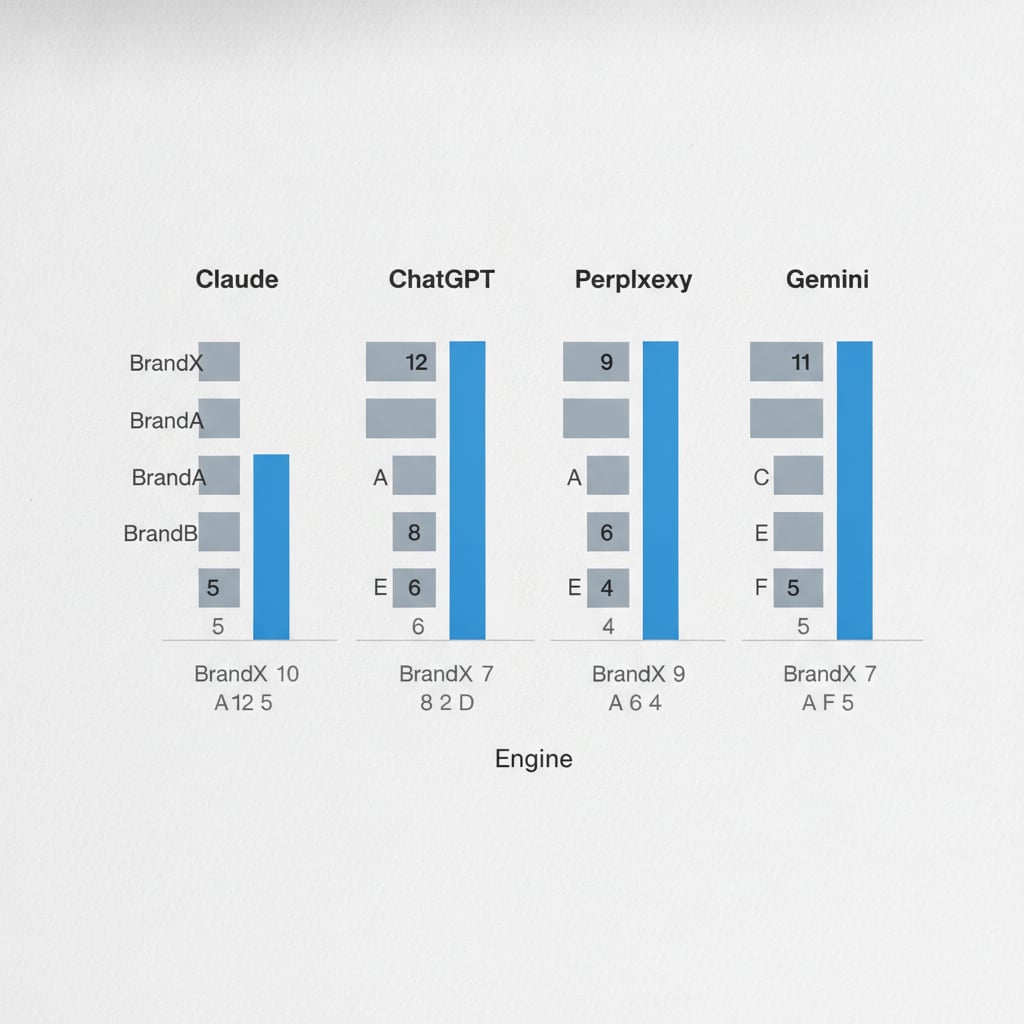
You cannot optimize what you do not measure.
In our 82-answer dataset, brand visibility varied dramatically by engine. For the "AI visibility tracking" buyer question specifically, Profound led with 6 appearances out of 16 checks. Peec AI and Otterly.AI each appeared 4 times. Rankscale appeared once. Most other tracked brands appeared zero times for that question.
Across the broader 92-answer pool covering 24 tracked questions, the distribution was similarly uneven: Peec AI appeared in 9 answers, Profound in 7, Otterly.AI in 7, Rankscale in 4, while Morningscore appeared in zero.
Exactly one brand in the GEO tools category was named by all four engines. Most tools were named by one engine or none at all.
The practical takeaway: check your brand's presence on each engine individually. Being visible on Perplexity does not mean you are visible on Gemini. Each engine draws from different source pools, weights citations differently, and updates on different schedules.
For the full appearance counts and pricing across all eight tracked competitors, see our complete tools comparison.
Practice 5: Build citation-worthy pages, not just rankable ones
Traditional SEO rewards pages that satisfy a searcher's intent. GEO rewards pages that engines treat as reliable sources worth citing to their users.
These overlap, but they are not identical.
A page can rank #1 on Google for a keyword and never appear in a single AI-generated answer. We saw this pattern repeatedly in our dataset. The pages engines cited as sources tended to share specific traits:
- They contained specific, scoped claims (numbers tied to a defined dataset, not vague assertions).
- They compared entities with consistent structure (same criteria applied to each, presented in tables or parallel sections).
- They were recently updated with dates visible in the content or metadata.
- They linked to primary sources for any third-party claims.
Pages that consisted entirely of opinion, even well-written opinion, were rarely cited. The engines have enough opinion. They need facts to anchor their answers.
Practice 6: Treat GEO as a feedback loop, not a one-time optimization
GEO is not a checklist you complete once. Engine answers change as new sources are indexed and as models are updated.
A brand that appears in an answer today may disappear next month if a competitor publishes better-sourced content on the same topic. A brand absent today can appear within weeks by publishing the kind of primary-research content described above.
The feedback loop works like this:
- Track your brand's appearance across engines for your key buyer questions.
- Identify questions where you are absent.
- Publish or update content for those questions with original data and extractable claims.
- Re-check after 2 to 4 weeks.
- Repeat.
This is not glamorous work. It is the work that compounds.
FAQ
What is generative engine optimization?
Generative engine optimization (GEO) is the practice of structuring your content so AI-powered engines cite your brand in their generated answers. It differs from traditional SEO, which focuses on ranking in a list of links. GEO focuses on appearing inside the answer itself. For a full definition, see our guide to what GEO is.
How do I know if AI engines are mentioning my brand?
You track it. Manually, you can ask each engine your key buyer questions and check whether your brand appears. At scale, tools exist to automate this. In our tracking of 21 buyer questions across 82 AI answers, most brands in the GEO tools category were named by only one engine or none at all. Consistent cross-engine visibility is rare.
Does traditional SEO still matter for GEO?
Yes. AI engines draw from indexed web content. Pages that are well-structured, recently updated, and authoritative in traditional search tend to be the same pages engines cite. GEO is not a replacement for SEO. It is an additional layer that rewards a specific kind of content: original, data-backed, and structured for extraction.
What kind of content do AI engines prefer to cite?
Based on our 82-answer dataset, engines cite pages that contain specific, scoped claims with visible sourcing. Opinion-only content, even when well-written, is rarely cited. The strongest signal is primary data that exists nowhere else on the web.
Are there tools that help with generative engine optimization?
Several tools track AI engine visibility, and they vary significantly in scope, pricing, and engine coverage. Our tools roundup compares eight options with full pricing and feature detail. SeeMySaas is one option in this space at $99/month with no contracts and the ability to cancel anytime (annual plan: $990). It is a newer entrant with fewer third-party reviews than more established competitors, but it tracks the same four engines and provides the kind of proprietary dataset used throughout this article.