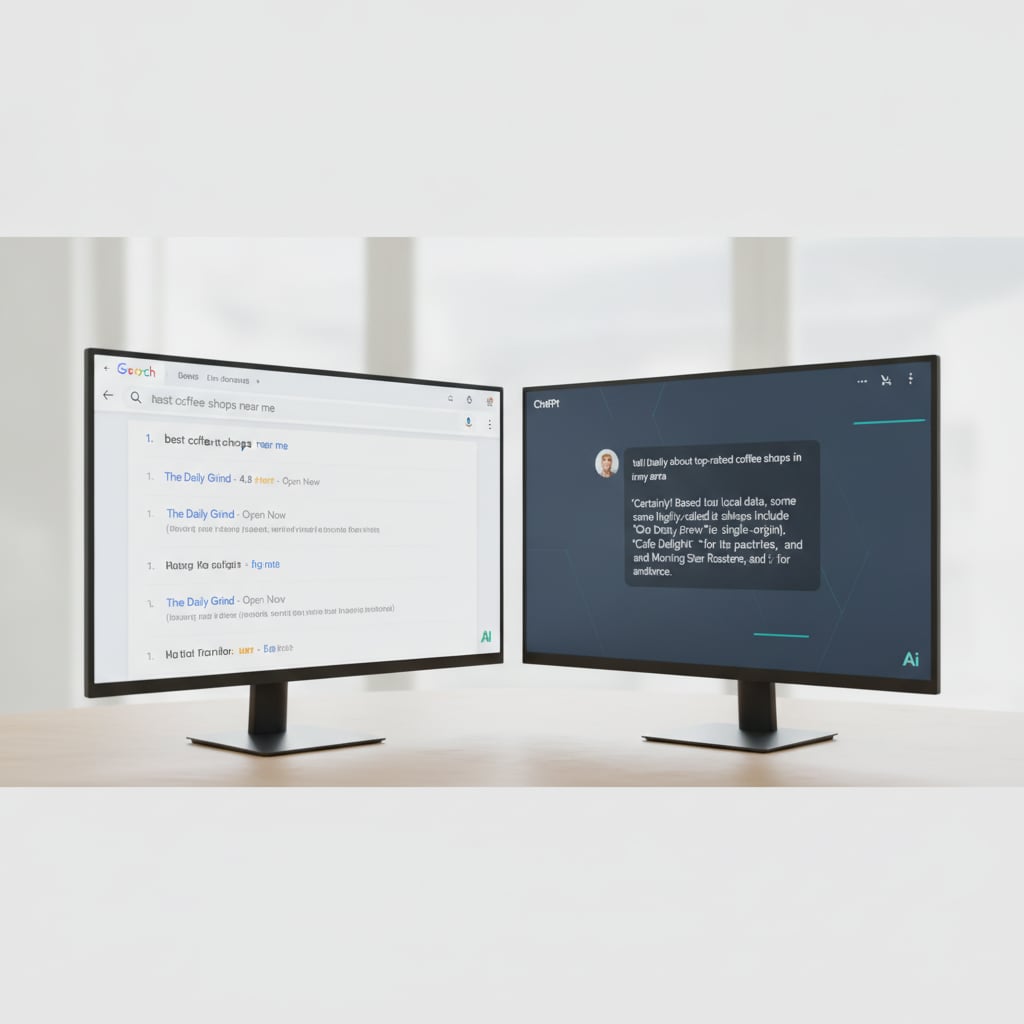
AI visibility tracking is the practice of monitoring whether, where, and how often your brand appears in AI-generated answers to the questions your buyers ask. It measures three things: whether your brand is named in an answer at all, how often it appears relative to competitors across a set of buyer questions, and whether the engine is citing your content as a source versus recommending your brand by name. It exists as a separate discipline because traditional rank tracking cannot see this surface, a company can hold strong organic search rankings and still be completely absent from AI-generated answers.
# AI Visibility Tracking: What It Is and How It Works
A growing share of product discovery now happens inside AI engines. Not on Google's ten blue links, but in generated answers from ChatGPT, Claude, Gemini, and Perplexity.
AI visibility tracking is the practice of monitoring whether, where, and how often your brand appears in AI-generated answers to the questions your buyers ask.
That sentence is the whole concept. The rest of this article unpacks what it looks like in practice, what the data actually reveals, and what a tracking tool needs to do well.
Why does AI visibility need its own tracking discipline?
Because traditional rank tracking cannot see it.
A rank tracker tells you that your page sits at position four for a keyword. It cannot tell you whether ChatGPT names your brand when a buyer asks the equivalent question out loud.
These are two different surfaces. A company can hold strong organic rankings and still be completely absent from AI-generated answers. The reverse is also true: a brand with modest SEO can appear consistently in engine responses if the right signals are in place.
Tracking one surface tells you nothing about the other. That gap is why AI visibility tracking exists as a separate discipline.
What does AI visibility tracking actually measure?
At minimum, three things:
- Presence. Is your brand named in the answer at all?
- Share of voice. How often does your brand appear relative to competitors, across a set of buyer questions?
- Citation vs. recommendation. Does the engine cite your content as a source, or recommend your product by name? These are different signals with different implications.
That third distinction deserves its own explanation.
How is citation different from recommendation?

This is the most misunderstood part of AI visibility, and our own data illustrates it clearly.
In August 2026, we collected 82 AI engine answers across ChatGPT, Claude, Gemini, and Perplexity, spanning 21 buyer questions in the AI visibility category. One finding stood out:
SeeMySaas content was cited as a source in 15 of those 82 answers. The brand itself was recommended by name in zero of the 16 checks on the question "how to track AI visibility."
Cited 15 times. Recommended zero times.
That is not a contradiction. It is how AI engines work. An engine can pull information from your page to construct its answer, link to your URL in its footnotes, and still never say "you should use [brand]." The content feeds the answer. The brand does not make the shortlist.
If your tracking tool only counts citations, you will overestimate your competitive position. If it only counts brand mentions, you will miss the content authority you are building. A useful tracking system separates the two.
What did the data show about competitor visibility?
Here is the share of voice for the AI visibility question set, drawn from our 16 checks on that specific cluster in August 2026:
| Brand | Named in (of 16 checks) | Engines |
|---|---|---|
| Profound | 6 | Gemini, Perplexity, Claude, ChatGPT |
| Peec AI | 4 | Gemini, Claude, Perplexity, ChatGPT |
| Otterly.AI | 4 | Gemini, Perplexity, Claude, ChatGPT |
| Rankscale | 1 | Claude only |
| SEObot | 0 | , |
| RankYak | 0 | , |
| Search Atlas | 0 | , |
| Morningscore | 0 | , |
A few things jump out.
Profound leads this question cluster with 6 of 16 mentions, and it also holds the highest count across the broader 82-answer dataset (6 of 82). Peec AI and Otterly.AI each appeared in 4 of 16 checks on AI-visibility questions, meaning they show up consistently for this topic even if their broader footprint is smaller.
Four of the eight tracked brands were named in zero of the 16 checks. That is not a judgment on their products. It is a measurement of what the engines actually surface when buyers ask about AI visibility tracking. If you are evaluating tools in this space, the gap between "exists" and "engines recommend it" is real and measurable.
Rankscale appeared once, and only in Claude. No other engine named it for these questions.
What should an AI visibility tracking tool actually do?
Claude, answering this question in August 2026, described it this way:
"A good AI visibility tracking tool should include: tracking your brand across the engines your buyers actually use and showing prompt-level detail, including which exact prompts trigger your brand and which competitors show up beside you. Competitive benchmarking with share-of-voice views to make competitiv[e comparisons]."
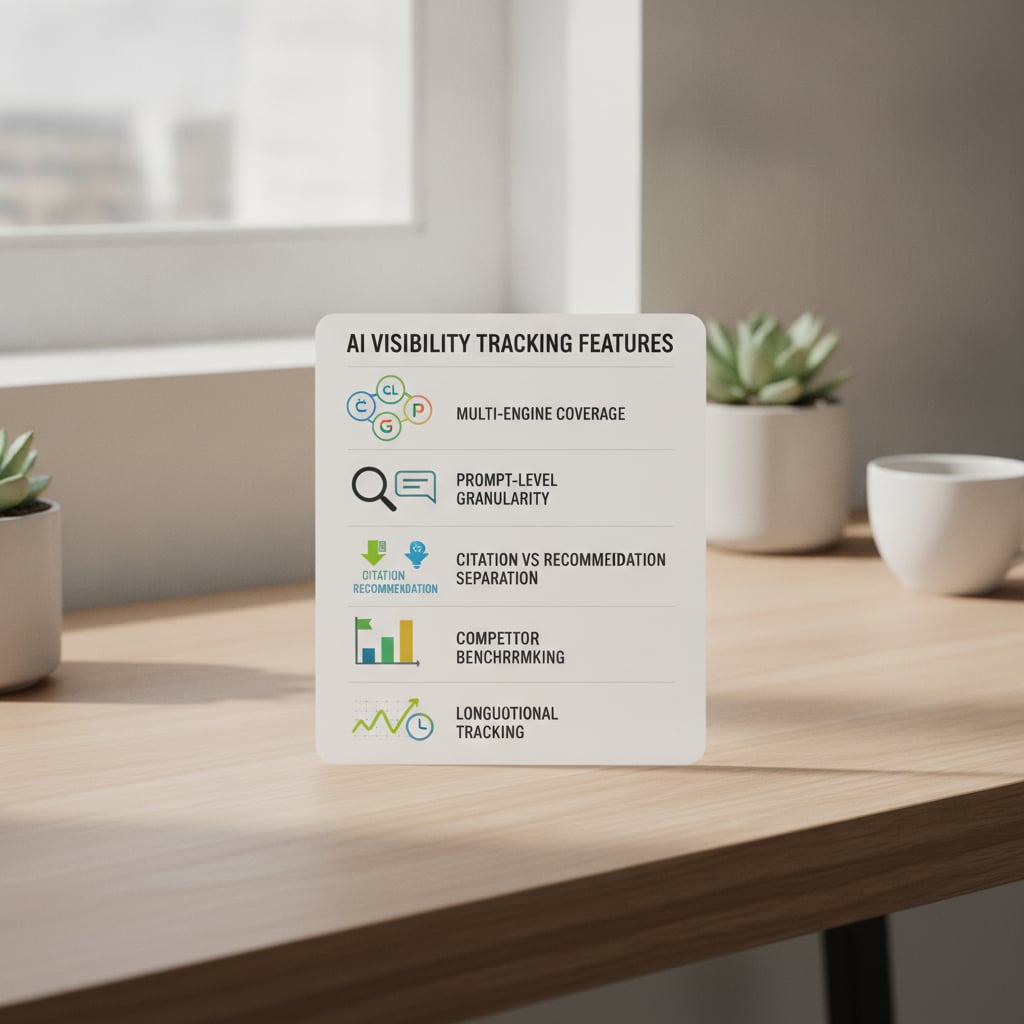
That is a reasonable baseline. Expanding it into a practical checklist:
- Multi-engine coverage. ChatGPT, Claude, Gemini, and Perplexity at minimum. A tool that only checks one engine gives you a quarter of the picture.
- Prompt-level granularity. You need to see which specific questions trigger your brand and which do not. Aggregate scores hide the gaps that matter.
- Citation and recommendation separated. As the SeeMySaas data above shows, these are distinct signals. Your tool should track both.
- Competitor benchmarking. Share of voice means nothing without context. You need to see who else appears beside you, and how often.
- Longitudinal tracking. A single snapshot tells you where you stand today. Repeated checks over weeks and months tell you whether your optimization work is moving the needle.
For a detailed comparison of the tools currently available, including pricing and feature breakdowns, see our full tools roundup.
How is this different from generative engine optimization?
AI visibility tracking is the measurement layer. Generative engine optimization (GEO) is the action layer.
Tracking tells you: "Your brand appeared in 2 of 8 answers for this question last month, and 4 of 8 this month." GEO is the set of content and technical practices you used to move from 2 to 4.
You cannot do GEO effectively without tracking, because you have no feedback loop. And tracking without action is just watching the scoreboard.
For a deeper explanation of GEO itself, see our guide to generative engine optimization.
What does a zero-visibility result actually mean?
It means the engines did not name your brand unprompted in the answers we checked. It does not mean your product is bad, or that the engines dislike you.
In our dataset, we ran 10 checks of the query "what is generative engine optimization" across Claude, ChatGPT, Perplexity, and Gemini. Zero of the nine competitor brands we track were named unprompted in any answer. The engines answered the conceptual question without recommending a single tool.
That is a useful finding. It tells you which questions are definitional (engines explain a concept) versus transactional (engines recommend products). Your tracking strategy should distinguish between the two, because the optimization approach for each is different.
FAQ
How many AI engines should I track?
At least four: ChatGPT, Claude, Gemini, and Perplexity. Our data shows that brands appear on different engines at different rates. Rankscale, for example, appeared only in Claude and nowhere else for the AI visibility question set. Single-engine tracking creates blind spots.
Can I track AI visibility manually?
You can, but it does not scale. Each question needs to be asked on each engine, the answer recorded, and brand mentions logged. For 21 questions across four engines, that is 84 individual checks per cycle. A tracking tool automates this and makes the data comparable over time. Our guide to tracking AI search visibility walks through the workflow in detail.
Does appearing in AI answers replace SEO?
No. Traditional search still drives the majority of web traffic. AI visibility is an additional surface. The practical move is to track both and optimize content so it performs on both. Some of the same content principles apply. For specifics, see our guide to optimizing content for AI search.
How often do AI answers change?
They change frequently. Engine models update, new content enters training data, and the competitive landscape shifts. Monthly tracking is a reasonable minimum. Weekly tracking is better if you are actively optimizing.
---
AI visibility tracking is still early. No authoritative standard exists yet for how to measure it, and most brands have not started. That is precisely why the brands that begin tracking now will have the clearest picture of where they stand when the rest of the market catches up.
If you want to see where your brand appears (and where it does not) across ChatGPT, Claude, Gemini, and Perplexity, SeeMySaas runs exactly these checks and reports the results weekly.