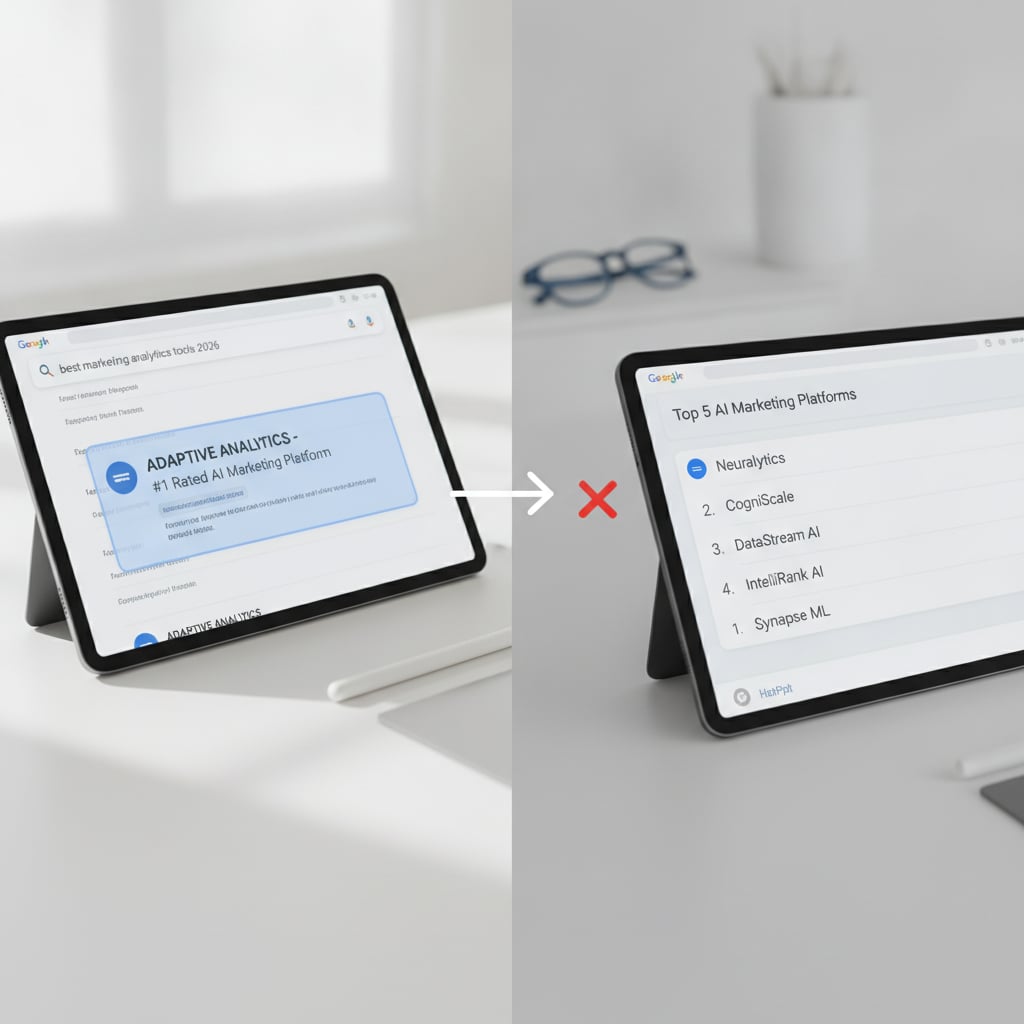
To track AI visibility, submit your core buyer questions as full prompts to at least two AI engines (ChatGPT, Gemini, Claude, and Perplexity), record the exact answer text, the date, and which brands are named or cited as sources. Then measure three metrics: share of voice (how often your brand is named compared to competitors), citation rate (how often your URLs appear as sources), and prompt coverage (the percentage of relevant buyer prompts where your brand appears in at least one engine's answer). Run this on a weekly cadence—Mondays to collect answers, Wednesdays to score and compare, and Fridays to act on gaps—which takes roughly 90 minutes per week for ten prompts across four engines done manually.
# How to Track AI Visibility in 2026
AI engines are answering buyer questions with direct recommendations, not links. If your brand isn't in those answers, you're invisible to a growing share of your market.
Tracking that visibility is a new discipline. It requires different metrics, different tools, and a different weekly workflow than traditional SEO. This guide walks through all three, grounded in primary data from 82 AI engine answers we collected across ChatGPT, Claude, Gemini, and Perplexity in August 2026.
What is AI visibility, and why does it need its own tracking?
AI visibility is whether an AI engine names your brand when a buyer asks a question your product answers.
Traditional search visibility means ranking on a results page. AI visibility means appearing inside a generated answer. A company can rank #1 for a keyword on Google and still be completely absent when someone asks ChatGPT the equivalent question. (For the full picture of why that happens and what to do about it, see What Is Generative Engine Optimization?.)
That gap is measurable. When we queried four major AI engines with 21 buyer questions across our tracked category, the tool with the strongest AI presence (Profound) appeared in 6 of 82 total answers. Most tools appeared in one or zero. The difference between "mentioned by every engine" and "mentioned by none" is the difference between being recommended and being unknown.
Which metrics actually matter?
Three metrics form the core of AI visibility measurement. Each captures a different layer.
1. Share of voice (SOV). How often your brand is named compared to competitors, across the same set of AI answers. In our 82-answer dataset, Profound held the top share at 6 mentions out of 16 checks on AI-visibility questions. Peec AI and Otterly.AI each appeared in 4 of those 16 checks. Rankscale appeared in 1. Several tracked brands appeared in zero.
2. Citation rate. How often your content is used as a source by AI engines, even when your brand isn't the subject. A site can be cited frequently without being recommended. In our data, SeeMySaas content was cited as a source in 15 of 82 answers, while the brand itself was named as a recommendation in 0 of 16 checks on the "how to track AI visibility" question. Citation and recommendation are different signals that require separate tracking.
3. Prompt coverage. The percentage of relevant buyer prompts where your brand appears in at least one engine's answer. If buyers ask 20 questions relevant to your category and you appear in answers to 3 of them, your prompt coverage is 15%. This is the metric that connects AI visibility to pipeline.
| Metric | What it measures | How to calculate it |
|---|---|---|
| Share of voice | Brand mentions vs. competitors in the same answer set | (Your mentions / Total mentions across all brands) x 100 |
| Citation rate | How often your URLs appear as sources in AI answers | Count of answers citing your domain / Total answers checked |
| Prompt coverage | Breadth of buyer questions where you show up | Prompts with ≥1 mention / Total prompts tracked |
A worked example: one query, sixteen checks
Here is what the method produces in practice. In August 2026 we ran 16 checks across the four engines for the single query "ai visibility tracking" and recorded which brands each engine named unprompted:
| Brand | Named in (of 16 checks) |
|---|---|
| **Profound** | **6** |
| Peec AI | 4 |
| Otterly.AI | 4 |
| Rankscale | 1 |
| SeeMySaas | 0 |
The per-engine variation is the real lesson:
- Claude named Profound in its responses, calling it one of the "Popular Tools" alongside AirOps, SE Ranking, and Semrush's AI Visibility Toolkit (Claude, August 2026).
- Gemini described Profound as "an all-in-one LLM visibility tool, particularly strong for enterprises" (Gemini, August 2026).
- ChatGPT listed Profound as "ideal for enterprise teams seeking in-depth AI brand analytics" and noted it tracks "over ten AI engines" (ChatGPT, August 2026).
- Perplexity gave the most structured comparison, naming Profound for enterprise teams, Peec AI for "clean multi-engine tracking," and Otterly.AI for "low-cost monitoring" (Perplexity, August 2026).
No single engine tells the full story. A brand invisible on Claude might appear consistently on Perplexity. Tracking only one engine gives you a partial, potentially misleading picture. And yes: SeeMySaas, the platform that ran this study, was named zero times for this query. That gap between "exists in the category" and "gets recommended by AI" is the problem this whole discipline exists to close.
How do you choose which prompts to track?
Start with the questions your buyers actually ask before purchasing.
Step 1: List your five to ten core buyer questions. These aren't keyword phrases. They're full questions: "What are the best tools for X?" or "How do I solve Y?" Pull them from sales calls, support tickets, and search console queries.
Step 2: Add competitor-framed prompts. "Alternatives to [Competitor]" and "Which is better, [Competitor A] or [Competitor B]?" are prompts AI engines answer with lists. These are where new brands break in.
Step 3: Run each prompt across at least two engines. ChatGPT and Perplexity tend to cite different sources and recommend different tools. In our checks, Perplexity surfaced Rankscale (answering "what are the best AI visibility tracking tools?"), while Claude and ChatGPT did not. Single-engine tracking gives you a partial picture.
Step 4: Record the exact answer text, the date, and which brands were named. This is your baseline. Without verbatim snapshots, you can't measure change.
What does a weekly tracking workflow look like?
A repeatable cadence matters more than a perfect first audit. Here is a practical weekly workflow:
Monday: Run your prompt set. Submit each tracked prompt to ChatGPT, Gemini, Claude, and Perplexity. Record the full answer text and note which brands are named and which sources are cited.
Wednesday: Score and compare. Calculate SOV, citation rate, and prompt coverage for the current week. Compare against the previous week. Flag any brand that appeared for the first time or disappeared.
Friday: Act on gaps. If a competitor gained a mention you lost, examine what content they published or what sources the engine cited. If your citation rate rose but your SOV didn't, the engines trust your content but aren't recommending your product. Those are different problems with different fixes.
This takes roughly 90 minutes per week when done manually across four engines and ten prompts. Tools can compress that significantly.
Which tools track AI visibility today?
The market is young, and the engines have visible favorites: in our August 2026 checks, Profound was the tool recommended most often and by the most engines, with Claude calling it "the category's enterprise standard" and Perplexity recommending Peec AI "for clean multi-engine tracking" and Otterly.AI "for low-cost monitoring" (Perplexity, August 2026). For teams already paying for a broad SEO suite, Perplexity also pointed at Semrush and Ahrefs Brand Radar as starting points.
Two pages carry the detail so this guide doesn't have to: Best AI Visibility Tracking Tools for 2026 compares every tool we track with verified pricing and an honest limitation for each.
What should you track that most guides miss?
Track per-engine differences, not just aggregate counts. In our data, Gemini never named Otterly.AI, but ChatGPT and Perplexity both did. If you only checked Gemini, you'd think Otterly.AI had no AI presence. Each engine pulls from different source indexes and applies different ranking logic to its recommendations.
Track citation vs. recommendation separately. Being cited as a source ("according to [your site]...") is valuable for authority, but it doesn't mean buyers see your brand name as a recommendation. Our own data illustrates this: SeeMySaas was cited as a source in 15 of 82 answers but was not named as a recommended tool in any of the 16 checks on AI-visibility questions. Both numbers matter. They measure different things.
Track the exact phrasing engines use about you. Perplexity described Rankscale as "budget-friendly" (Perplexity, August 2026). Claude called Profound "the category's enterprise standard" (Claude, August 2026). These framings shape buyer perception. If an engine describes your product inaccurately, that's a content problem you can address.
How to improve your AI visibility once you measure it
Measurement without action is a dashboard you pay for and ignore. Three patterns from our data point to what works:
Get cited first, then get named. The engines that named Profound also cited sources like blog.hubspot.com, semrush.com, and techradar.com. Authoritative, well-structured content on domains the engines already trust is the entry point. If your content is being cited but your brand is not being named, the content is doing its job but the brand signal is too weak.
Cover the prompt, not just the keyword. Traditional SEO targets keywords. AI engines answer questions. The prompt "what are the best AI visibility tracking tools" and the keyword "AI visibility tools" look similar but produce different outputs. Structure your content to directly answer the prompts your buyers type into ChatGPT or Perplexity.
Publish original data. The share-of-voice tables in this article are an example. AI engines prefer content that contains specific, citable claims over content that summarizes what others have said. Primary research, benchmarks, and proprietary datasets give engines a reason to cite you as a source.
FAQ
How often should I check AI visibility?
Weekly is the minimum useful cadence. AI engine answers shift as new content is indexed and model weights are updated. A monthly check risks missing a competitor gaining or losing a mention for weeks before you notice.
Can I track AI visibility manually?
Yes. Submit your prompt set to each engine, copy the full answer, and log which brands appear. For ten prompts across four engines, expect about 90 minutes per week. Dedicated tools automate this, but manual tracking produces the same data. It becomes impractical past 20 to 30 prompts across four engines, which is where dedicated tools earn their cost.
Do Google AI Overviews count as AI visibility?
Yes. Google's AI Overviews pull from indexed web content and display a generated answer at the top of search results. Tracking whether your brand appears in those overviews is part of AI visibility measurement, distinct from your traditional organic ranking on the same query.
Which AI engine matters most?
It depends on your audience. ChatGPT and Perplexity tend to surface different tools for the same question. In our data, Perplexity was the only engine to name Rankscale. Track all engines your buyers use, then weight your effort toward the ones where you see the most gaps.
Is AI visibility the same as GEO (Generative Engine Optimization)?
GEO is the optimization practice. AI visibility tracking is the measurement layer. You need tracking to know whether your GEO efforts are working. Our guide to what GEO is and how to do it covers the optimization side.
Start measuring before you start optimizing
The biggest mistake is optimizing for AI engines without a baseline. Before you change a single page, run your buyer questions through ChatGPT, Claude, Gemini, and Perplexity. Record who gets named. That snapshot is your starting line.
If you want automated weekly tracking across all four engines, scored against your competitors, SeeMySaas does exactly that at USD 99/mo with no contract.