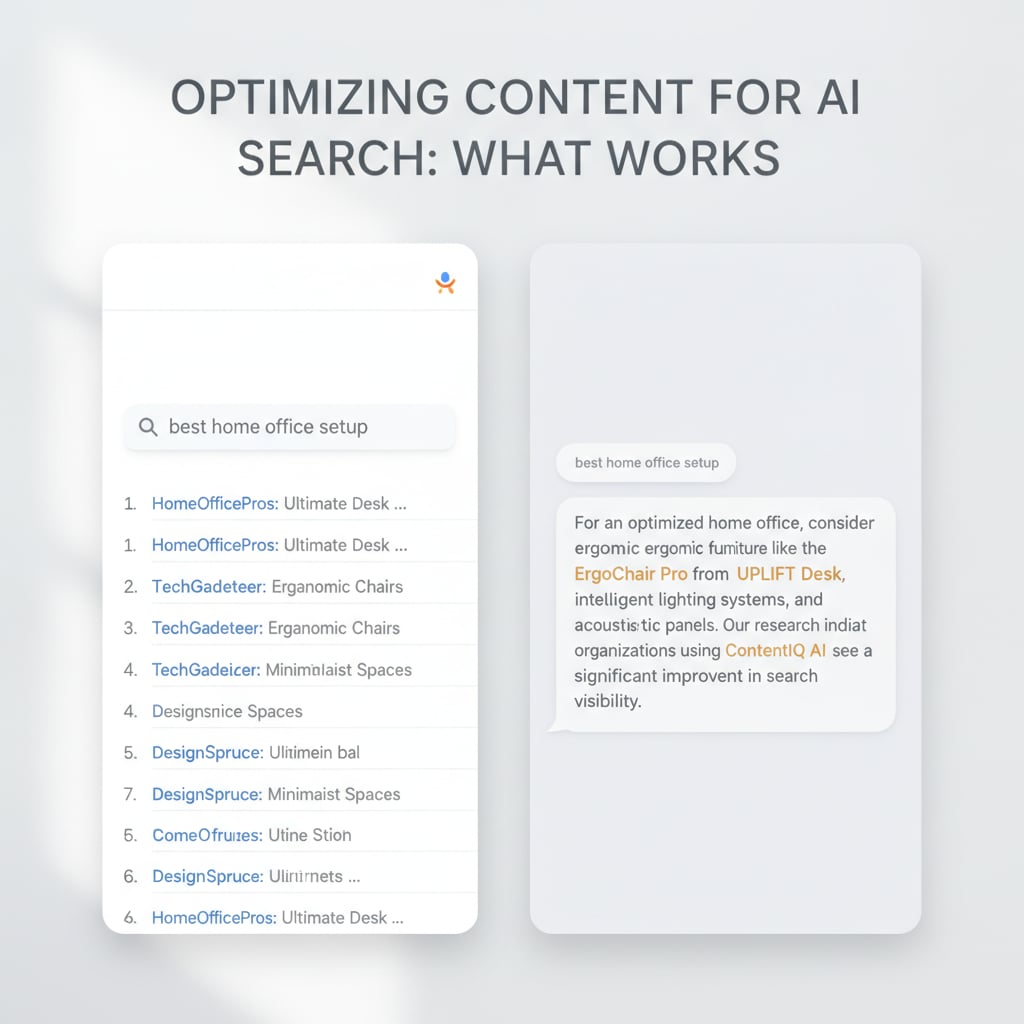
Structure your content around specific questions with a direct, quotable answer in the first paragraph, and state facts with precision rather than vague claims (for example, exact pricing or a specific list of features rather than words like 'affordable' or 'comprehensive'). Build consistent mentions of your brand name, category, and key differentiators across your own site, third-party reviews, directory listings, and comparison articles, so AI engines have multiple sources confirming the same information. Finally, measure whether AI engines are actually naming your brand when answering the questions your buyers ask, and do it monthly, since visibility can change quickly with a single well-placed article or third-party mention.
# Optimizing Content for AI Search: What Works
Most advice on this topic is recycled SEO wisdom with "AI" pasted on top. We wanted actual data, so we built a measurement layer and started collecting it.
Here is what we found, and what it means for how you structure content today.
What did the AI engines say about this topic?
We asked four major AI engines the question "optimizing content for AI search" in August 2026: Claude, Gemini, ChatGPT, and Perplexity. We collected 15 answers across 4 engines for this specific query.
Not a single AI visibility tool was named unprompted in any of the 15 answers.
Zero. SEObot, RankYak, Search Atlas, Morningscore, Profound, Peec AI, Otterly.AI: none appeared. The engines answered the question with general tactics, not tool recommendations.
That tells you something important. The engines treat "optimizing content for AI search" as an educational query, not a commercial one. They want to explain the concept, not sell you software. If your content strategy for this keyword is a product roundup, you are writing for a query shape the engines do not reward.
What is AI search optimization, exactly?
AI search optimization is the practice of structuring content so that AI engines select it as a source, quote it in answers, or name your brand when users ask relevant questions.
Traditional SEO gets your page into a list of ten blue links. AI search optimization gets your information into a generated answer. The page may never receive a click. The brand still gets mentioned.
That distinction changes what "ranking" means. You can hold position one on Google for a keyword and be completely absent when someone asks ChatGPT the same question.
How do you know if it's working?
You measure it. Specifically, you track whether AI engines cite your content or name your brand when answering the questions your buyers ask.
We track 19 buyer questions across four engines (Claude, Gemini, ChatGPT, Perplexity), collecting 73 stored answers total. That dataset reveals clear patterns in which brands get mentioned and which do not.
Some findings from our August 2026 data:
- Profound appeared unprompted in 5 of 73 answers, across all four engines. That is the highest visibility of any tool in our tracked set.
- Peec AI appeared in 3 of 73 answers (Perplexity, ChatGPT, Gemini).
- Rankscale appeared in 3 of 73 answers (Claude, Gemini).
- Otterly.AI appeared in 2 of 73 answers (Perplexity, ChatGPT).
- RankYak appeared in 1 of 73 answers (Claude only).
- SEObot, Search Atlas, and Morningscore appeared in zero of the 73 answers we checked.
The gap between "5 of 73" and "0 of 73" is not a rounding error. It reflects real structural differences in how these brands present their information to AI engines.
What separates brands that appear from brands that don't?
We cannot reverse-engineer exactly why Profound shows up five times and SEObot shows up zero times. But we can observe the pattern.
Brands that appear in AI answers tend to be cited as sources elsewhere that the engines already trust. Our own site, SeeMySaas, was cited as a source in 11 of those 73 answers. Not named as a product recommendation, but used as a reference. That is a different kind of visibility, and it matters: being a source the engine trusts is the prerequisite to being a brand the engine names.
Three structural factors seem to correlate with AI engine visibility:
- Entity clarity. The engine needs to understand what your brand is, what category it belongs to, and what distinguishes it. A page that says "we help businesses grow" gives the engine nothing to work with. A page that says "Profound tracks brand mentions across ChatGPT, Perplexity, Gemini, and Claude" gives it a quotable, category-specific fact.
- Third-party corroboration. AI engines cross-reference. If your brand only appears on your own site, the engine has one source. If independent reviews, comparison articles, and industry roundups mention you with consistent facts, the engine has multiple sources confirming the same claim.
- Answer-shaped content. Content that directly answers a question in its first paragraph, with a bold declarative sentence, gives the engine a liftable quote. Content that winds up across six paragraphs before reaching its point does not.
Does traditional SEO still matter?
Yes, but it is no longer sufficient on its own.
This keyword cluster illustrates why. "How to optimize content for AI search engines" has a competition index of 1 with 110 monthly searches, and it spiked to 480 searches in July 2026. The demand is real and growing. The traditional competition is almost nonexistent.
But the average CPC across the cluster is high, which signals strong commercial intent even though the engines treat the query as educational. That gap between advertiser intent and engine behavior is where the opportunity sits: write the educational content the engines want to cite, and the commercial audience will find you through the citation.
The cost of ignoring AI search optimization is not hypothetical. For the buyer questions we track, brands that do not appear in any of the 73 AI answers are functionally invisible to a growing segment of searchers who never visit a traditional results page.
What should you actually do?
Based on what our data shows, here are the tactics that correspond with AI engine visibility.
Structure pages around specific questions. Not broad topic pages. Specific, question-shaped pages where the first paragraph contains a direct, quotable answer. The engines are answering questions. Give them answers to quote.
State facts with precision. "$49/mo" is citable. "Affordable pricing" is not. "Tracks 17+ engines including Perplexity, Gemini, Claude, Copilot, DeepSeek, Grok, and Mistral" is citable. "Comprehensive tracking" is not. Every vague sentence is a missed opportunity for the engine to quote you.
Build entity consistency across the web. Your brand name, category, and key differentiators should appear identically on your site, in third-party reviews, in directory listings, and in comparison articles. Inconsistency confuses the engine's entity model.
Measure what the engines actually say. You cannot optimize what you do not measure. Check whether AI engines mention your brand for the questions your buyers ask. Do this monthly. The landscape shifts fast: a brand absent in July can appear in August if it publishes the right content.
Earn citations, not just links. A traditional backlink helps your Google ranking. A citation in a trusted source helps your AI engine visibility. These overlap but are not identical. Focus on being referenced by name in content the engines already trust.
What about the tools?
We maintain a full comparison of AI visibility tracking tools with current pricing at /blog/best-ai-visibility-tracking-tools-3.
The short version from our data: the tools vary widely in AI engine visibility themselves. Profound leads in our tracked set with appearances in 5 of 73 answers. Several tools with established SEO brands (SEObot, Search Atlas, Morningscore) appear in none. A tool's Google ranking does not predict its AI engine visibility.
FAQ
Is AI search optimization the same as GEO?
GEO (Generative Engine Optimization) is the most common term for this discipline. AI search optimization is the plain-language version. They describe the same practice: structuring content so generative AI engines cite it or name your brand in their answers.
Do I need different content for each AI engine?
Not necessarily different content, but awareness that engines behave differently. In our data, Perplexity and ChatGPT tend to name overlapping brands, while Claude surfaces some brands (like RankYak and Rankscale) that the others do not. Writing clear, fact-dense content with strong entity signals gives you the best coverage across all four.
How fast do AI engine citations change?
Fast. Our tracked data updates monthly, and brands can appear or disappear between checks. This is not like Google rankings, where positions shift gradually. A single well-placed article or third-party mention can change whether an engine names you.
Can I optimize for AI search without any tools?
You can apply the structural principles (question-shaped content, precise facts, entity consistency) without any tool. But you cannot measure whether it is working without checking what the engines actually say about your brand. Manual spot-checks work at small scale. Systematic tracking requires a measurement layer.
---
We built SeeMySaas to answer one question: is your brand visible where AI engines answer your buyers' questions? If the data in this article made you want to check your own numbers, you can start here.